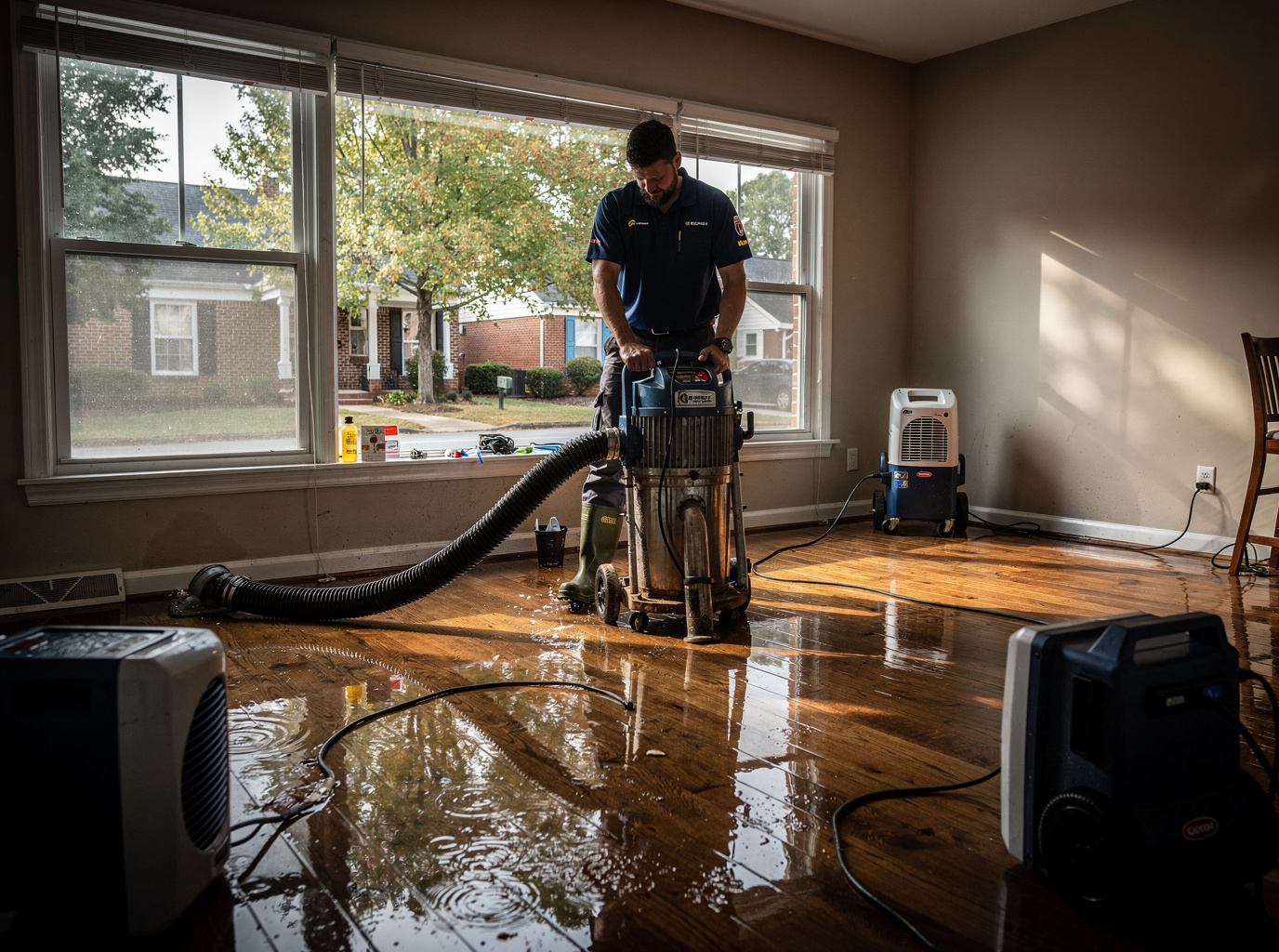
Older housing stock in neighborhoods like Trinity Park and Old West Durham often features knob-and-tube wiring and galvanized pipes that fail under pressure, sending water into plaster walls and hardwood subfloors. In Durham's humid subtropical summers, even a few inches of standing water can push relative humidity above 80 percent inside the structure, forcing mold growth within 48 hours if extraction is delayed. Technicians must account for the clay-heavy soils around North Durham that hold moisture against foundations, making perimeter drainage checks part of every job.
After heavy rain events that also affect nearby Raleigh, water frequently enters through low-grade entries at the American Tobacco Campus adaptive-reuse buildings and the raised basements common in Brightleaf. Removal crews use truck-mounted vacuums rated for 200-plus gallons per minute because smaller portable units cannot keep up with inflow from saturated ground. Hidden pockets behind brick veneer or under Sarah P. Duke Gardens-adjacent homes require moisture mapping with penetrating meters to avoid leaving damp cavities that later cause warped flooring.
Durham County permitting rules require documentation of removed water volume on any job that involves sewage or gray water, so crews log readings before and after extraction. Edge cases include multi-story leaks where water migrates down interior walls into the first-floor joist bays; these demand temporary shoring before full drying begins. Homeowners in Downtown Durham often discover that insurance deductibles rise sharply once Category 2 water is confirmed, making early professional extraction the difference between a contained loss and a full gut renovation.
Technician insight
In Durham, the thing that catches most people out with Emergency Water Removal is how quickly the high summer humidity re-saturates older plaster and hardwood in Trinity Park homes once the pumps leave; if you do not pull the baseboards and check the subfloor the same day, you will be back in two weeks for mold remediation that started in the joist bays.
North Durham basement after overnight rain
Water entered through a low window well and pooled four inches deep across a finished basement in a 1940s brick home. Extraction crews found the water had wicked up behind the drywall on two walls and into the carpet pad. They removed 1,800 gallons, cut away saturated baseboards, and mapped moisture into the subfloor before turning the space over to drying equipment.
Emergency Water Removal Services We Offer
✓Burst Pipe Extraction
Immediate isolation and removal of water from supply-line failures common in pre-1960 homes in Trinity Park and Old West Durham.
✓Flooded Basement Water Removal
High-volume extraction from rain or groundwater intrusion in low-lying North Durham and Brightleaf properties where clay soils trap moisture against foundations.
✓Appliance Leak Cleanup
Rapid pump-out and containment after water heater or washing machine failures that spread across finished floors in Downtown Durham apartments and condos.
✓Storm Damage Water Extraction
Removal of rainwater that enters through roofs or windows during summer thunderstorms affecting homes near Durham Bulls Athletic Park and the American Tobacco Campus.
✓Sewage Backup Extraction
Licensed handling and removal of contaminated water from municipal line backups that occur after heavy rains in older Durham County neighborhoods.
Emergency Water Removal Cost in Durham, NC
| Service | Typical Range | What Affects It |
|---|---|---|
| Residential extraction under 500 sq ft | $650–$1,200 | Increases with sewage contamination or multi-story migration |
| Basement extraction over 1,000 sq ft | $1,400–$2,800 | Clay soil and poor drainage around North Durham homes add time |
| Appliance leak response | $450–$850 | Depends on finished flooring type and hidden wall moisture |
| Storm water removal | $800–$1,600 | Roof access and debris removal affect total |
Ranges are typical for Durham, NC and confirmed with an exact written quote before any work starts.
How it works
- 1
Arrival And Safety Assessment
Technicians arrive within the service window, shut off affected utilities, and test for electrical hazards before any extraction begins.
- 2
Standing Water Removal
Truck-mounted and portable extraction equipment pulls bulk water from floors, carpets, and wall cavities while containing runoff.
- 3
Moisture Mapping
Infrared and penetrating meters locate hidden moisture behind walls and under subfloors in older Durham construction.
- 4
Documentation And Containment
Photos, moisture logs, and temporary barriers are installed before the drying phase is handed off to the restoration team.
Pricing
Upfront quotes after inspection; final cost depends on water volume, access, and whether Category 2 or 3 water is present.